



【明報專訊】THE DEADLY FIRE at Wang Fuk Court in Tai Po has thrown building management and bid‑rigging into the spotlight. The authorities now plan to amend the law to make owners' corporations (OCs) more transparent and prod owners into taking greater interest in how their buildings are run.
Improving building management is a shared responsibility between OCs and property management companies. Yet measures such as capping proxy votes may not suffice to stop bid-rigging interests from steering decisions at owners' meetings. The government needs to step in more actively and help small flat‑owners keep a closer watch over property managers and OCs.
The government says it will amend the Building Management Ordinance (BMO) on five fronts: raising the quorum required for owners to attend in person when voting on major repairs or large procurements; capping instruments of appointment (proxy votes) to prevent owners being "authorised" or "signed for" without their knowledge; tightening the declaration-of-interests regime; clarifying rules on convening, agendas, cancellation and postponement of owners' meetings; and giving the authorities greater powers to step in when management committees fail to function.
Individual flat-owners, busy with their own lives, often pay scant attention to how their OCs are run. Where transparency is thin, bid-rigging groups exploit the gaps, planting their own people inside. Abuse of proxy votes, and even allegations of ballot-stuffing, is routine whenever an owners' meeting or committee election looms.
In 2024, the Legislative Council amended the BMO to require, for major repairs costing over $30,000 per flat, a minimum in-person turnout of 5% of owners (or 100 owners, whichever is fewer). It also criminalised improper keeping of OC records. The government now proposes to raise these thresholds further: the bigger the contract, the higher the quorum. Buildings must post notices listing who holds each flat's proxy. Declarations of interest would cover OC members, property management firms and project consultants, which is crucial intelligence for owners.
Even so, deeper infiltration of estate management means that higher voting thresholds do not guarantee immunity from manipulation. Capping proxy votes raises the bar, but does not eliminate the problem: bid-rigging groups can still find ways to secure proxies, and the new measures may not fully prevent impersonation of non-resident owners.
OCs are integral to district governance, and the Home and Youth Affairs Bureau, Home Affairs Department (HAD) and District Offices could track them far more closely. OC disputes have proliferated of late: some owners, denied major-repair documents and alleging forged proxies, have petitioned the HAD for intervention under the BMO; others moaned to District Offices that their OCs had shoved owners' meetings ten kilometres off-site—only to be fobbed off with "the corporation's been spoken to". Giving officials more power over OCs and tighter oversight of managers is welcome. What matters most, though, is their willingness to wield it—and step in when it counts.
明報社評2026.01.16:推動業主參與大廈管理 政府介入須更積極主動
大埔宏福苑大火令大廈管理及「圍標」問題成為社會關注焦點。當局建議修例加強法團運作透明度、提高業主對物業管理的關注。
改善大廈管理,業主法團與物管公司皆有責任。然而「授權票」設上限等做法,未必足以防範圍標勢力左右業主大會決定。政府須更積極介入,協助小業主加強監督物管公司及法團運作。
政府表示將從五大方向修訂《建築物管理條例》(下稱《條例》),包括提高議決大維修工程或大額採購時業主親身出席投票的比例門檻,以及就委任代表文書制度(即「授權票」)設定數量上限,避免業主「被委任、被簽署」。另外,當局亦會完善利益申報制度,釐清業主大會的召開、議程、取消、延期等安排,以及賦予當局更多權力,在法團管委會不能正常運作時介入。
小業主日常生活各有各忙,未必太留意法團運作情况;部分法團的透明度不足,圍標集團利用種種手段滲透其中,安插「自己人」,每遇業主大會或法團換屆選舉,授權書制度遭濫用甚至出現造票紛爭,時有所聞。
前年立法會通過修訂《條例》,每戶需付3萬元以上的大維修工程,業主親身出席業主大會人數門檻要最少5%(或100名),另外亦將不妥善保存法團管理文件刑事化。現在政府進一步提高表決門檻,合約金額愈高,投票的人數要求也愈高,同時又規定大廈須張貼告示,列出各單位授權予誰;利益申報涵蓋法團成員、物管公司及工程顧問,對業主而言,也是相當重要的資訊。
不過,圍標集團滲透屋苑管理,表決門檻提高,不代表他們無法耍手段引導業主投票意向;授權票數量設限,增加圍標難度,但圍標勢力仍有方法取得授權票,新措施未必防止不住在單位的業主遭偽冒授權票。
業主法團制度,是地區治理的一環,民青局、民政事務總署及各區民政處在很多事情上,可以跟得更緊更貼。近年屋苑法團爭議事件頻發,有業主不滿法團不肯交出有關大維修的文件,甚至涉嫌偽造授權書,前往民政事務總署請願,要求署方按《條例》介入監察法團;亦有業主向地區民政處投訴,法團安排業主大會在離開屋苑10多公里外的地方舉行,收到的回覆只是「已勸喻法團」。修例賦予當局更多權力介入法團管理和加強監管物管公司,固然重要,但更重要是當局願意積極運用手上權力,適時介入。
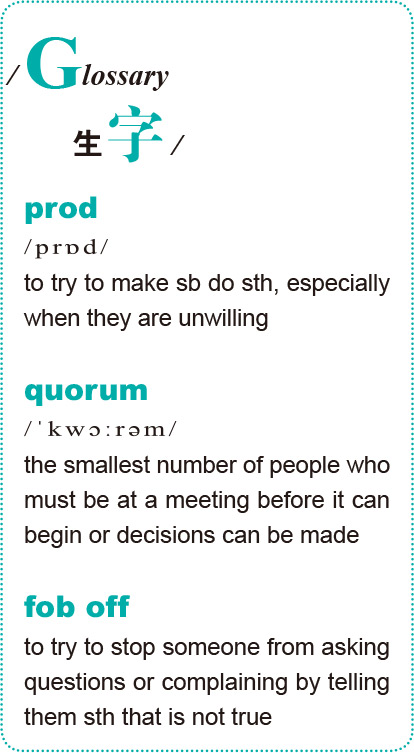
■ Glossary 生字 /
prod : to try to make sb do sth, especially when they are unwilling
quorum : the smallest number of people who must be at a meeting before it can begin or decisions can be made
fob off : to try to stop someone from asking questions or complaining by telling them sth that is not true


發表評論